









Executive summary of report provided to ICG clients. The Private Company Trends series assesses corporate health through an analysis of up to 170,000 datapoints from private company financial data, across key metrics such as EBITDA, revenue, margins, debt & interest coverage. The ICG Private Company Database is now 17 years’ old, providing unique insights through economic cycles.

Introduction
Strong performance despite global headwinds
Private companies performed strongly in 2025 and into early 2026 despite high economic and geopolitical volatility, according to data tracked by the ICG Private Company Database. Proprietary data tracking close to 500 private companies in the US and Europe show that median private company EBITDA in Europe, the UK and the US grew at a strong pace through 2025 and broad debt metrics remained healthy. Most macro and micro indicators indicate that at an aggregate level the positive performance has continued into 2026.
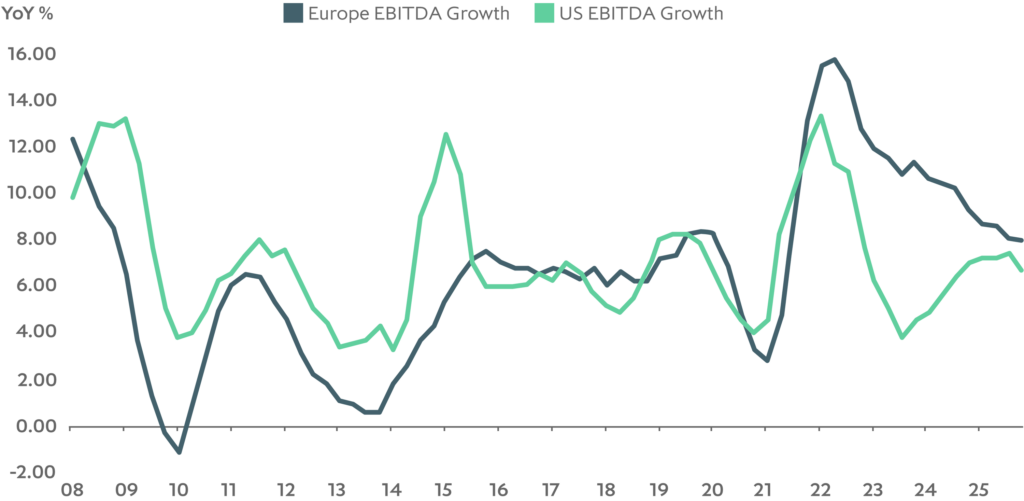
Europe (including the UK) EBITDA growth continued to normalise from exceptionally high post-Covid levels, but remained above historical average levels, rising by around 8% in Q4 2025. Performance has been supported by continued outperformance of companies in the technology sector, steady growth of companies in the healthcare, industrial and consumer discretionary sectors, and a rebound in the growth of companies in the materials sector.
In the US, EBITDA growth extended the recovery that started in late 2023, supported by stabilising revenue growth and improving margins, with median EBITDA growth rising to 6.2% in Q4 2025, up from a cyclical low of 3.9% in Q3 2023. Rising technology and healthcare company EBITDA helped boost growth as margins continued to improve and steady performance by industrial companies helped offset weaker consumer discretionary and consumer staple sector performance.
Debt metrics remained healthy through 2025. In Europe, median leverage (Net Debt/EBITDA) stood at 5.3x in Q4 2025, up from 5.1x a year ago, with the median private company interest coverage ratio (EBITDA/Cash Interest) rising to 2.5x. In the US, the median leverage ratio held steady at 5.6x, down from a peak of 6.0x in Q4 2023 and the median interest coverage ratio rose to 2.2x, up from 1.9x in the same period last year, as interest rates declined and EBITDA growth picked up.

On our base case of slower economic growth and higher inflation in the US and Europe in 2026, as the lagged impact of higher energy prices kicks-in, we think median EBITDA growth is likely to moderate as topline growth slows, and margins come under pressure as costs prove more difficult to pass on than in 2022. However, as we expect the economic slowdown to be modest and expect a swift normalisation of growth and inflation in 2027 (Please see: Middle East Update: Implications of the war for the global economy and markets), the slowdown in EBITDA growth is likely to be manageable in our view.

While the slowdown in headline median EBITDA growth is likely to be modest, as the credit cycle moves into its sixth year of post-Covid expansion, we think idiosyncratic risks and performance dispersion at a company level will likely continue to rise, with financial structures the primary differentiating factor. Rapid innovations in artificial intelligence are likely to add to the dispersion, with early adopters and companies with nimble management and natural complementarity to AI in a position to outperform.
More moderate growth and higher inflation caused by the sharp rise in energy prices in the first half of 2026 will likely make for a more difficult operating environment for many companies in the latter part of 2026. However, strong fundamentals coming into 2026 and an expected relatively swift normalisation of economic growth and inflation in 2027 should hold most companies in good stead in our view. In this environment we think sector and company performance dispersion will continue to rise, with rigorous bottom-up analysis and stress testing more critical than usual. At a broad level we continue to favour strategies with conservative financial structures, downside protection, inflation and interest rate hedging properties, and companies with highly visible and predictable cashflows.
Resilient private company EBITDA growth








 Back
Back